 Parking Map

October Birthstone Jewelry For Those Ladies Born In The Fall
October 20th, 2015
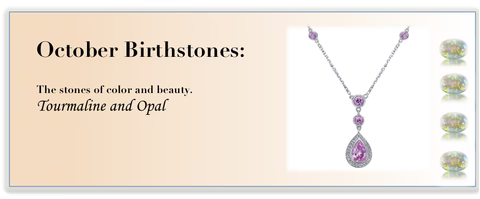
October Birthstones: Opal & Tourmaline
Meaning, Jewelry & Buying Guide
Two of the most colorful and distinctive gemstones in the world — everything you need to know about October's extraordinary birthstones.
October is one of only three months with two recognized birthstones — and both are extraordinary. Opals display a color-play found in no other gemstone on Earth. Tourmalines come in more colors than any other gem family, including stones that show multiple colors simultaneously within a single crystal.
At Smith's Jewelers in Noblesville, IN, we help customers find opal and tourmaline jewelry for October birthdays, anniversaries, and meaningful gifts. If you're searching for October birthstone jewelry near Noblesville, our team will help you find the right piece.
Quick Answer: The October birthstones are opal and tourmaline. Opals are prized for their unique color-play and symbolize hope, creativity, and protection. Tourmalines come in virtually every color and symbolize peace and creativity. Both make visually striking and meaningful gifts for October birthdays.
What Are the October Birthstones?
The October birthstones are opal and tourmaline. Both are recognized by the American Gem Society. Opal is the traditional birthstone; tourmaline is the modern alternative.
October is one of only three months with two official birthstones, and the pairing is among the most visually interesting in the calendar. Opal is unlike any other gemstone — its internal structure diffracts light into a moving, shifting display of color that changes with every angle and every light source. Tourmaline is the world's most colorful gem family, available in every color of the spectrum including stones that display two or more colors within the same crystal.
Whether you're drawn to the dreamy, iridescent fire of an opal or the vivid, singular color of a fine tourmaline, October birthdays have options that set them apart from almost any other birth month.
Opal
Opal: Meaning & History
Opals symbolize hope, creativity, imagination, and protection. Ancient Romans considered them the most precious of all gemstones, containing the colors of every other gem.
The word opal is believed to derive from the Sanskrit upala, meaning "precious stone." To the ancient Romans, opal was the most prized gemstone of all — they called it opalus and believed it contained within its shifting colors the fire of ruby, the sea-green of emerald, the gold of topaz, and the blue of sapphire, all in a single stone. Pliny the Elder described it as holding "the living fire of the carbuncle, the brilliant purple of amethyst, and the sea-green of emerald."
Across many cultures, opal was associated with prophecy and foresight — the belief that its shifting, iridescent colors revealed truths that ordinary eyes couldn't see. In the Middle East, it was said to fall from the sky during lightning storms. Aboriginal Australians, who produce most of the world's finest opals, hold deeply spiritual traditions around the stone — some stories describe the Creator descending to Earth on a rainbow, and where his feet touched the ground, the stones came to life with color.
Today, opal symbolizes hope, creativity, and protection. It's one of the most emotionally resonant gemstones — a stone people either immediately fall in love with or feel is too extraordinary for everyday life. Both responses are completely understandable.
Opal Properties & Facts
Opals rate 5.5–6.5 on the Mohs scale — softer than most gemstones and requiring care in everyday wear. Their distinctive color-play is caused by the diffraction of light through microscopic silica spheres within the stone.
- Play of color — The defining feature. Caused by light diffracting through a regular arrangement of microscopic silica spheres within the stone. The size and regularity of the spheres determines the colors displayed. No two opals are identical.
- Types — White/light opal (translucent with color-play on a white base), black opal (most valuable, color-play on a dark base), boulder opal (thin opal layer on ironstone matrix), crystal opal (transparent body), and fire opal (translucent orange to red, from Mexico).
- Origin — Australia produces over 90% of the world's fine opals, particularly black opal from Lightning Ridge and white opal from Coober Pedy. Ethiopian opals have become increasingly significant and widely available.
- Hardness — 5.5–6.5 on the Mohs scale. Significantly softer than most other jewelry gemstones. Best suited for pendants, earrings, and rings in protective settings. Requires careful storage away from harder stones.
- Care — Avoid prolonged exposure to extreme heat or dry conditions, which can cause crazing (fine surface cracks). Clean with a soft damp cloth only — not ultrasonic cleaners or harsh chemicals. Doublets and triplets (layered opal composites) must never be soaked.
- Natural vs. doublet/triplet — Natural opals are solid through. Doublets consist of a thin opal slice bonded to a dark backing. Triplets add a clear quartz cap. Doublets and triplets look similar to natural opals but are far less valuable — always ask which you're buying.
Tourmaline
Tourmaline: Meaning & History
Tourmaline symbolizes peace, creativity, compassion, and balance. It has been prized across cultures for centuries, often mistaken for other gemstones due to its extraordinary range of colors.
Tourmaline's name comes from the Sinhalese word turamali, believed to mean "stone of many colors" — a fitting description for the most color-diverse mineral family known to gemology. For centuries, tourmalines were misidentified as other gemstones: the famous "Caesar's Ruby" in the Swedish Crown Jewels, worn for centuries as a prized red stone, was eventually identified as a red tourmaline. A large "emerald" in the Portuguese Crown was also later found to be tourmaline.
Pink and red tourmalines were particularly prized in Imperial China. The Empress Dowager Cixi, who ruled China in the late 19th and early 20th centuries, had a deep passion for pink tourmaline and imported vast quantities from the United States — making San Diego's Himalaya Mine one of the most productive tourmaline sources in the world at the time.
Today, tourmaline is associated with peace, emotional healing, and creative energy. Its extraordinary range of colors makes it one of the most versatile and personalized gifting options in the gemstone world — there is genuinely a tourmaline for every personality.
Tourmaline Properties & Facts
Tourmaline rates 7–7.5 on the Mohs scale — durable for everyday wear. It comes in more colors than any other gem family, and some crystals display multiple colors simultaneously (watermelon tourmaline shows pink and green in the same stone).
- Color range — Virtually every color of the spectrum, including colorless, black, neon blue-green (Paraiba), deep red (rubellite), vivid pink, violet, green, yellow, and multi-colored (watermelon tourmaline shows concentric pink and green in a single cross-section).
- Paraiba tourmaline — The most prized variety, discovered in Brazil's Paraíba state in the 1980s. Its neon, electric blue-green color — caused by copper — is unlike anything else in gemology. Fine Paraiba tourmaline commands prices that rival top sapphires and rubies.
- Hardness — 7–7.5 on the Mohs scale. Durable and well-suited for all jewelry types including rings and bracelets worn daily.
- Origins — Brazil is the most significant source overall. Other major sources include Mozambique, Nigeria, Afghanistan, and Madagascar. The United States (Maine and California) also produces fine tourmalines.
- Treatment — Many tourmalines, especially pink and red varieties, are heat-treated to improve color. This is stable and widely accepted. Some are irradiated to enhance color — ask your jeweler about treatment history on significant purchases.
- Value range — Common tourmalines in green or brown tones can be very affordable. Vivid pink, rubellite, and indicolite (blue) command premium prices. Fine Paraiba tourmaline is among the most expensive gemstones per carat in the world.
Best October Birthstone Jewelry Ideas
Opals are best in protective settings — pendants, earrings, and bezel-set rings. Tourmalines work beautifully in any jewelry form, with the choice of color allowing for deeply personal customization.
Both stones offer distinctive and memorable jewelry options. Here's what works best for each:
- Opal pendants — The ideal way to showcase opal's color-play. A pendant moves with the wearer and catches light from multiple angles, which is exactly how opal's iridescence is best appreciated.
- Opal earrings — Studs or drops in protective gold settings are one of the most popular ways to wear opal — visually striking while the setting protects the stone's edges from impact.
- Opal rings (bezel set) — A bezel setting wraps the stone in metal, protecting opal's relatively soft edges. Classic and protective for everyday wear.
- Tourmaline rings — Tourmaline's excellent durability makes it ideal for rings. A vivid pink tourmaline in rose gold, a deep green in yellow gold, or a Paraiba blue in platinum are all exceptional statement pieces.
- Tourmaline earrings & pendants — The color range means tourmaline can be matched to virtually any personal style. A pair of pink tourmaline drop earrings is one of the most versatile gift options in colored gemstones.
- Watermelon tourmaline slices — Cross-section slices of watermelon tourmaline — showing pink interior and green rim — are increasingly popular as pendant and earring centerpieces for their organic, artistic quality.
- Custom pieces — Both opal and tourmaline are excellent for custom jewelry design. Tourmaline especially, given the breadth of color options, is ideal for designing around a specific color palette or personal preference.
Opal vs. Tourmaline: How to Choose
Choose opal for its unique, dreamy color-play and emotional resonance. Choose tourmaline for durability, a specific color preference, or versatile everyday jewelry.
- Loves something one-of-a-kind? — Opal. No two opals are identical, and the color-play is unlike any other gemstone in the world. It's genuinely impossible to replicate.
- Wants a specific color? — Tourmaline. Whether she loves deep pink, vivid green, electric blue, or warm peachy tones, tourmaline almost certainly has it — often in the same stone.
- Active lifestyle, ring wearer? — Tourmaline. At 7–7.5 Mohs, it handles daily wear significantly better than opal's 5.5–6.5.
- Pendant or earrings only? — Opal becomes much more practical in non-ring settings where impact risk is lower.
- Collector or gem enthusiast? — Paraiba tourmaline or a fine black opal from Lightning Ridge. Either is genuinely extraordinary and holds lasting value.
October birthstone jewelry ranges from a few hundred dollars for quality tourmaline accents or white opals to several thousand for fine black opals or Paraiba tourmaline. Our team at Smith's Jewelers in Noblesville will walk you through all the options and help you find the right stone for your style and budget.
Why October Birthstone Jewelry Makes a Perfect Gift
Opal and tourmaline are among the most visually distinctive gemstones available — gifts that immediately stand apart from conventional jewelry choices and carry deep personal meaning.
- October birthdays — Having two birthstones gives October birthdays genuine flexibility. You can match the stone to the person's personality — opal for the dreamer, tourmaline for the one who loves bold color.
- 8th wedding anniversary — Tourmaline is the traditional gift for the 8th anniversary, making it a meaningful milestone piece for couples reaching a significant marker.
- 14th wedding anniversary — Opal is the traditional 14th anniversary stone — a deeply symbolic choice for the occasion.
- The person who wants something different — If she gravitates toward the unusual and unexpected, both opal and tourmaline deliver something that most people have never seen up close.
- Collectors & gem enthusiasts — A fine black Lightning Ridge opal or a neon Paraiba tourmaline is the kind of gift that gets talked about for decades.
October Birthstone FAQs
The October birthstones are opal and tourmaline. Opal is the traditional birthstone, known for its unique play of color. Tourmaline is the modern alternative, prized for its extraordinary range of colors — virtually every color of the spectrum is available in tourmaline.
No — this is a superstition that originated largely from a single 19th-century novel (Sir Walter Scott's "Anne of Geierstein," 1829), in which an opal figured ominously in the plot. Before that novel, opals were among the most beloved and prized gemstones in history. Ancient Romans, Greeks, and Eastern cultures all considered opal extremely auspicious. The "bad luck" association is a literary invention, not a historical tradition.
Paraiba tourmaline — discovered in Brazil's Paraíba state in the 1980s — is the most valuable variety. Its neon electric blue-green color, caused by copper, is completely unlike any other gemstone. Fine Paraiba tourmaline commands some of the highest per-carat prices in the colored gemstone market, often rivaling top sapphires and rubies.
With care, yes — but opal requires more attention than most gemstones. At 5.5–6.5 on the Mohs scale, it scratches more easily. Keep opal away from other harder gemstones in storage, avoid impact, and don't expose to extreme heat or prolonged dryness. Opal pendants and earrings are generally better suited for daily wear than rings.
Watermelon tourmaline is a bi-colored variety that shows a pink or red center and a green rim within the same crystal — mimicking the cross-section of a watermelon. When sliced perpendicular to the crystal's length, these color zones are clearly visible and are increasingly popular in pendant and earring designs for their unique, organic appearance.
Smith's Jewelers on the Square at 98 N 9th Street in Noblesville, IN carries opal and tourmaline jewelry, as well as custom design services for one-of-a-kind pieces. Our team will help you find the right stone and setting for any budget. Walk-ins welcome.
Shop October Birthstone Jewelry
in Noblesville, IN
Whether you're looking for an opal pendant, a vivid tourmaline ring, or something completely custom, our team at Smith's Jewelers will help you find the perfect piece for any October birthday or occasion.